Return to Teaching eHRAF: Tile View | Table View
View exercise overview
Class size: Any
Source: Produced by HRAF
Learning Objectives
Does the exercise compare 2 or more cultures? Yes
Subject selection: Single subject specified by teacher
Subjects/OCMS, if applicable: Divination, Oracles, Augury, Prediction, Belief, Ritual
Region selection: open (student choice)
Region, if applicable: Various
Culture selection: Student chooses from entire collection
Cultures/OWCs, if applicable:
Samples:
Classroom Guide
Instructions for navigating eHRAF included? Yes
Assignments for students to complete in groups? Yes
Assignments for students to complete on their own? Yes
Instructions for Microfiche version? No
Francine Barone, HRAF at Yale University
Download the eHRAF Workbook version (PowerPoint):
In this activity
- Understand the concept of divination
- Learn about divination and oracles across cultures
- Compare and contrast cultural practices
- Read and interpret ethnographic data
Reading
- Aroney, M. and D. Zeitlyn (eds). 2024. Divination: oracles & omens. Oxford: Bodleian Library Publishing.
- Espírito Santo, Diana. (2019) 2023. “Divination”. In The Open Encyclopedia of Anthropology, edited by Felix Stein. Facsimile of the first edition in The Cambridge Encyclopedia of Anthropology.
- Zeitlyn, David. 2025. In Cameroon, truth-telling spiders untangle the future. Aeon.
- Barone, Francine. 2026. “Coping with Uncertainty: Oracles, Divination and Decision-Making”. Human Relations Area Files at Yale University.
Dealing with the unknown
Humans are naturally adept decision-makers, generally taking into account all available knowledge at our disposal and filtering out what we believe to be the most important criteria for our choices. Every day, each of us makes a series of both small and large decisions. Whether serious or inconsequential, these decisions require weighing pros and cons to arrive at the best path to take. However, we don’t always have all the required information at hand. Without being able to predict the outcome of our choices before we make them, how can we ever know what to do, or what *not* to do?
Defining Divination
“A good first way of approaching divination is to consider it as a means of arriving at answers to a personal or social quandary. As such, divination may be diagnostic, in that it offers advice, guidance, rules, and taboos to be followed. It can also be forecasting, by predicting future events, and it may even be interventionist, by intervening in the receptor’s spiritual and physical health or indeed in their destiny” (Espirito Santo 2019).
“Techniques of divination come in many forms. Divination often involves the interpretation of patterns or clues – in natural things such as seeds, bones, guts, birds and celestial bodies, as well as in human-made or manipulated things such as cards, dice, images and candles – by means of skilled and usually standardized methods. Divination may also involve more direct commerce with non-human others such as deities, demons or ancestors. Some of the forms of divination presented in this book call for the use of ceremonial paraphernalia, sacred objects such as altars, candles and texts, or even mathematical tools such as astrolabes and astronomical tables” (Aroney and Zeitlyn 2024: 16-18).
Mambila Spider Divination
Watch this short video and read the following essay from Prof. Zeitlyn (Oxford University) describing Mambila spider divination: https://aeon.co/essays/in-cameroon-truth-telling-spiders-untangle-the-future
Then, visit https://nggamdu.org/ to learn more about Mambila diviners (“Meet the Diviners”) and to see videos of the spider oracle in action (“The Spider’s Answers”).
Based on what you have watched and read, answer the following questions:
Questions
- Describe Mambila spider divination: Who may practice it, and what are the steps?
- What kinds of questions can be asked to the spider?
- What are some questions that shouldn’t be asked, and why?
- How are the answers interpreted?
- How does Mambila spider divination compare to other types of decision-making tools or practices that you have encountered? Explain your examples.
eHRAF Activity 1: Azande Poison Oracle
Read pages 258-264 & 293-301 on Azande poison oracles in Witchcraft, oracles and magic among the Azande by Evans-Pritchard (1937)
eHRAF link: https://ehrafworldcultures.yale.edu/cultures/fo07/documents/071/pages/269
Questions
- Describe the Azande poison oracle. How does it work?
- Why is the oracle “one of the most important institutions of social life” for the Azande?
- What are some examples of reasons why people might consult the poison oracle?
- How is the trustworthiness of an oracle’s verdict determined?
- Can you think of any practices or customs in your own society that are similar in any way to poison oracle consultations?
eHRAF Activity 2: Cross-Cultural Comparison
In this activity, you will compare and contrast divination practices and practitioners across cultures using ethnographic evidence from the eHRAF World Cultures database.
Instructions
Select one aspect or type of divination to compare across three cultures from different parts of the world. Create a table to store your findings, or add your selected paragraphs to an eHRAF Notebook. Then, write a brief summary comparing your selected cultures.
eHRAF Research tips
To get started, identify a feature of divination that interests you. For example, divination using objects such as cards, dice, books or bones; via spirit mediums; or by interpreting omens. You can also focus on divination for diagnosing and explaining illness or bodily harm, or for predicting the outcome of future events.
To begin your research, conduct an Advanced Search in eHRAF World Cultures using the OCM subject identifiers: 787 Revelation and Divination and/or 791 Magicians and Diviners. Use the filters in your search results to narrow by region. Then, explore your search results for interesting data. Once you have found a topic of interest, you can return to your Advanced Search form to add more specific keywords or culture names.
If using eHRAF Notebooks to store your findings, remember that you can annotate and label paragraphs inside your notebook to organize your thoughts. Learn more about Notebooks here.
Example Comparison
In this example, we will learn more about scapulimancy: a type of divination that involves reading signs such as cracks or markings that appear on an animal’s shoulder blade bone after it has been burned. The following eHRAF Notebook contains example paragraphs from eHRAF World Cultures on the subject of scapulimancy.

Example Notebook: If you have registered for an eHRAF account, you can view and add this notebook to your Notebooks in eHRAF by clicking on this link: https://ehrafworldcultures.yale.edu/notebooks/c605c220-1986-402e-8261-f18d8fbcc45a
Note: you must be logged in to your eHRAF account to view the shared notebook.
Blank Table Template
If you are not using eHRAF Notebooks, a table like the one below can be used to organize your results before writing your summary.
| Culture Name (OWC) | Source | Page reference | Paragraph text | Notes |
| Greeks (EH01) | Herzfeld, Michael. 1985. The Poetics of Manhood: Contest and Identity in a Cretan Mountain Village. 1985 | 247 | Glendiot shepherds perform a kind of scapulomancy, or divination with the shoulder blade of a sheep or goat. … These concerns are all matters about which Glendiots exhibit considerable anxiety: marriage, death, wives’ fidelity, childbearing, social worth, the size of flocks, the incidence of raids, and the behavior of the natural elements, as well as the acquisition of material wealth and the general well-being and prosperity of the household. | |
Instructor Notes
If modifying the eHRAF Activity 2 for groups, Notebooks can be shared among collaborators. The assignment can also be adjusted to include more than 3 cultures or more than one type of divination for groups of 3 or more.
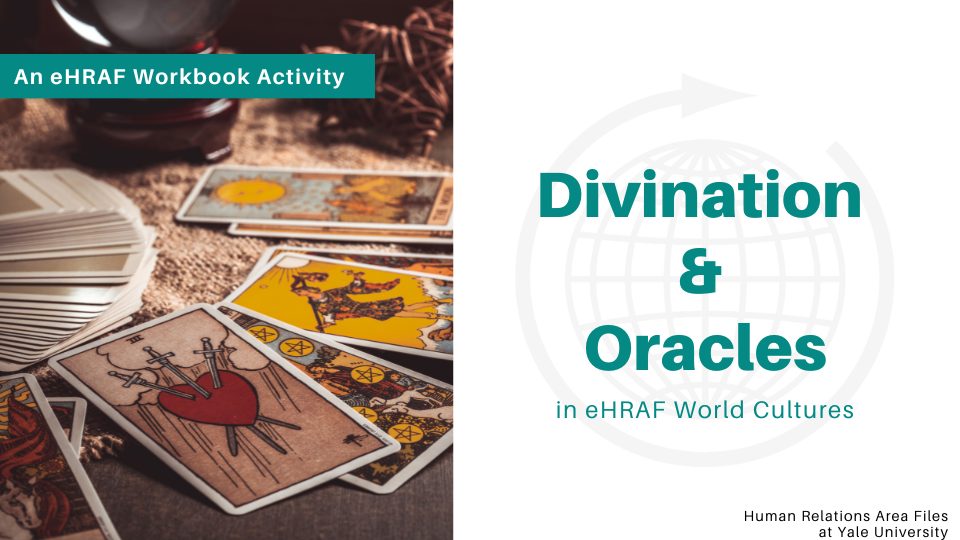
Image credit: Mystical Tarot Card Reading Setup on Wooden Table by Natalie Goodwin from Pexels
