By Matthew Longcore, Ph.D.
Television shows which explore the connection between food and culture continue to be enjoyed by viewers around the world. In an earlier HRAF post titled Food Anthropology on Television: Ethnographic Culinary Adventures, HRAF profiled two popular TV shows in which the narrator takes an ethnographic approach to learning about food in different societies – Parts Unknown hosted by the late Anthony Bourdain and Uncharted hosted by Gordon Ramsay.
The latest show to capture audiences is Best of the World hosted by Antoni Porowski. The show’s host, Antoni Porowski, is a New York Times bestselling author, public speaker, and executive producer. Like Uncharted, this new show is produced by National Geographic.
“This is like a beautiful representation of cultures. It’s food, but it’s also a history of the people. It’s the sights, the sounds.”
– Antoni Porowski
In this article, we will explore the first episode which focuses on the food, architecture, and culture of Mexico City. Porowski introduces Mexico City, the capital of modern-day Mexico, as a city “built on what was once the capital of the Aztec empire” and which was originally known as Tenochtitlan. He previews the episode by stating, “I’ve handpicked six experiences that capture its global spirit and ancient roots.” Of these six experiences, three are centered around food.
Food: Guava Roll
Rosetta Bakery
Chef Elena Reygadas
View this post on Instagram
Chef Elena Reygadas is the proprietor of two eateries visited by Porowski, Rosetta Bakery and Restaurante Rosetta. Porowski begins his culinary journey with a visit to the bakery, which is known in Spanish as Panadería Rosetta. The bakery is famous for blending classic European baking techniques with traditional Mexican ingredients. “There’s a star attraction, Rosetta’s signature delicacy, the guava roll,” states Porowski, which is made with “buttery pastry, guava jam, [and] cream cheese.”
Guava (Psidium guajava) is native to Mesoamerica and the tropical basin of central-southern Mexico. Domestication in the region spans at least 2,500 years, with historical documentation confirming deep roots in the culinary and medicinal traditions of indigenous cultures. The iconic guava and cheese pastry (rol de guayaba) originates from Panadería Rosetta in Mexico City. It features a buttery, croissant-like dough wrapped around a vibrant guava paste and creamy, tart cream cheese.
View this post on Instagram
Information about the diet of ancient people in Mesoamerica, including the use of guava, can be found in the eHRAF databases. Here is an excerpt from eHRAF Archaeology:
“Flora characteristic of tropical Mesoamerica had as great an influence on the economy as it had in other areas of similar climate. Naturally an abundant quantity of fruit such as guava or sapote was available, as well as the rubber which gave its name to the region. But the basis of diet was agriculture, with the same plants that still characterize southern Mexico. The famous trilogy of corn, beans, and squash is still found in sites like Tres Zapotes.” (Bernal 1969: 21)
Food: Tamales
Restaurante Rosetta
Chef Elena Reygadas
View this post on Instagram
“I think the most beautiful thing about cooking is to share.” – Chef Elena Reygadas
Tamales are a traditional Mesoamerican dish made of masa (nixtamalized corn dough) that is stuffed with various savory or sweet fillings, wrapped in a banana leaf or a corn husk, and steamed. Nixtamalization is an ancient Mesoamerican process of soaking and cooking dried corn in an alkaline solution, such as lime water or wood ash. This process softens the mixture, enabling removal of the hull and making it digestible. Nixtamalization creates nixtamal, which is ground into masa (or dough) for tamales and tortillas.
Originating as early as 10,000 BP, tamales were historically utilized by ancient civilizations such as the Olmec, Maya, and Aztec peoples. Tamales served as portable food for nomadic peoples such as hunters and warriors. The term “tamale” derives from the Nahuatl word tamalli, which translates as “wrapped.” Since corn was considered sacred, tamales were frequently offered to the gods during religious rituals.
Porowski describes the historical significance of tamales, stating, “Tamales, corn parcels so good, the Aztecs offered them to the gods. Today they’re the ultimate comfort food.”
This statement is echoed in a document in eHRAF World Cultures which references the Florentine Codex:
“Everyone made plain tamales and fruit tamales for themselves; they offered them as gifts to their gods.” (Sahagún, Anderson, and Dibble, 1951: 99)
The Florentine Codex is a manuscript created by Franciscan friar Bernardino de Sahagún and a group of Nahua elders, authors, and artists. The J. Paul Getty Trust describes the Florentine Codex as follows:
“Written in parallel columns of Nahuatl and Spanish texts and hand painted with nearly 2,500 images, the encyclopedic codex is widely regarded as the most reliable source of information about Mexica culture, the Aztec Empire, and the conquest of Mexico.” (Getty Institute 2026)
The ritualistic aspect of tamales is also mentioned in eHRAF Archaeology:
“The rituals and feasts of this month were dedicated to the goddess of the young maize plant, Xilonen. In her honor, the ruler provided the populace with an abundance of tamales for seven days, and later offered the people green corn tortillas, indicating that the maize had just begun to ripen. This feasting helped offset the effects of a particularly difficult time of year.” (Berdan 1982: 16)
The tamales at Restaurante Rosetta have an ingredient called Huitlacoche which gives them their distinct flavor. Porowski describes this ingredient as follows, “A very special fungus…some people call it the truffle of Mexico…‘Huitlacoche’ might just be the best kept secret since mezcal.” This ingredient is used used to make corn and Huitlacoche tamales with smoked cream.
Huitlacoche is also described similarly in an ethnography in eHRAF World Cultures:
“The fungus is consumed by some North Americans, however: in some trendy U.S. restaurants it is apparently sold as ‘Mexican truffles’ or ‘caviar Azteca.’ Throughout much of Mexico it goes by the Nahuatl name huitlacoche.” (González 2001: 150)
The tamales are seasoned with an aromatic herb, called “epazote.” The use of this herb for cooking tamales is described in eHRAF World Cultures:
“Several perennial aromatic herbs are both cultivated and found in a wild state. The leaf of the acuyo (genus Piper, possibly sanctum ) is used in cooking; a small piece is indispensable in tamales. A leaf of epazote ( Lippia berlandieri Schauer) is sometimes used to season beans.” (Foster 1942: 20)
Porowski concludes his visit to Restaurante Rosetta by thanking Chef Reygadas for sharing her cultural heritage, stating, “I can’t thank you enough for taking the time to show me who you are through your food.”
Food: Tacos
Maizajo
Chef Santiago Muñoz
Tacos originated in ancient Mesoamerica, with indigenous civilizations such as the Aztecs and Mayans using freshly pressed, nixtamalized corn tortillas as edible wraps for ingredients like fish, beans, and chili peppers.
According to Porowski, “there’s basically a taqueria on every corner” in Mexico City. Porowski visited Maizajo, where the proprietor – or propios – is Chef Santiago Muñoz. Food establishments of this sort, which in the past were more commonly run by women to supplement the household income, are now often full-fledged businesses in their own right. This ethnography in eHRAF World Cultures describes tacos among the foods available from propios:
“Those that must be considered propios are the people who sell food in the form of tacos, tejate , ices, agua fresca (flavored water), tortillas or clayudas (a hard tortilla ). This is a reflection of two circumstances. First, the goods sold can be produced from start to finish using materials that can be grown or obtained within the household production unit. Second, there is a virtual monopoly on these items since they can be easily moved from the homes where they are made to the plaza and as often as demand indicates on a given Sunday.” (Diskin 1979: 97)
View this post on Instagram
Porowski describes the traditional methods used by Santiago to make tortillas: “He’s all about making them the traditional way. These days, most are made from highly processed industrial corn flour…Santiago uses only native ‘heirloom’ corn. It’s brought from small farms and processed the way his ancestors would have done for thousands of years.” Santiago states, “We have 64 different corn in Mexico…blue, red, white, and different sizes.” Porowski adds, “The ancient people of Mesoamerica first harvested corn about 9,000 years ago and they’ve spent more than three millennia perfecting tortillas.”
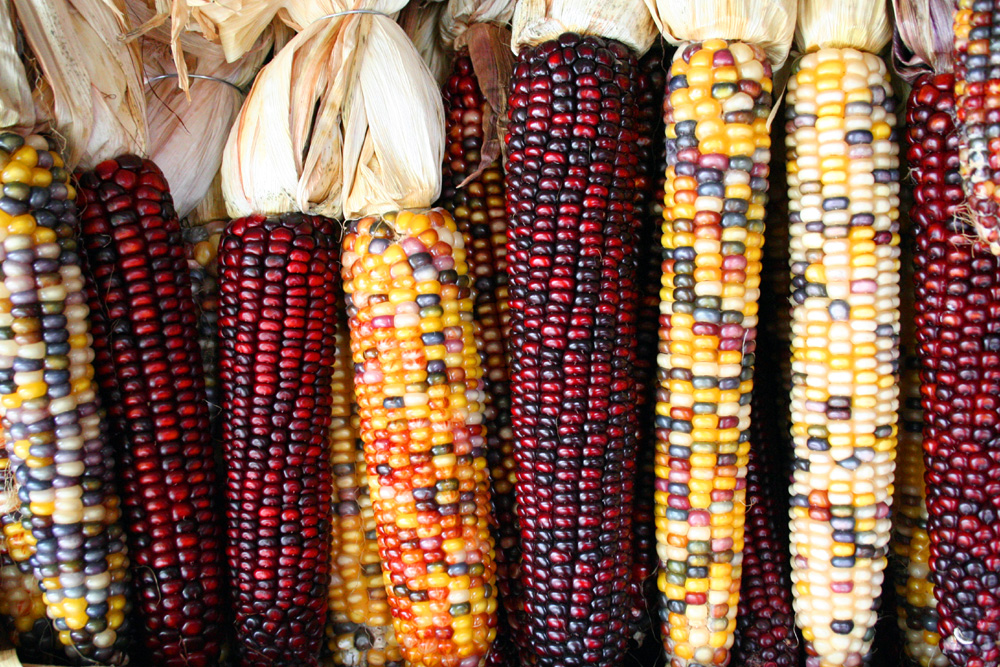
“Corncobs” by Sam Fentress, CC BY-SA 2.0 via Wikimedia Commons
The cultural significance of maize to Mesoamerican peoples is described in eHRAF World Cultures:
“Like all Mesoamerican peoples before and since, the Aztecs depended heavily on maize, or corn ( Zea mays), for their sustenance…Maize is a remarkable plant whose domestication made possible the evolution of Mesoamerican civilizations. Maize exists in many different varieties, adapted to specific local conditions of soil and climate, and it can grow nearly everywhere in Mesoamerica except for the cold high mountains. Indeed, the northern boundary of Mesoamerica as a cultural area is usually defined as the northern limits of rainfall-based maize cultivation. A highly productive plant, with caloric yields among the highest of any major world food crop, maize is also high in protein. Animal sources of protein were in short supply in ancient Mesoamerica, so maize was an essential component of the diet.” (Smith 1997: 64)
Porowski describes the process of turning corn into tortillas used for making tacos, “First he cooks the corn with lime. The calcium hydroxide kind, not the fruit. A process called ‘nixtamalization’…The lime helps break down the corn, so when it’s ground up, it makes a softer, silky, more nutritious dough.”
Santiago states, “We’re Aztecs, we’re Mesoamericans. The tradition is there; we need to keep it alive.” Porowski replies, “Preservation though food.” According to Porowski, Santiago demonstrates a “passion for preserving his heritage and showcasing Mexico’s homegrown corn.”
Explore More
eHRAF Workbooks are available on topics related to food and subsistence, including Agrarian Societies, Consuming Milk, and Hunter-Gatherer Societies. Teaching eHRAF also has resources related to the topic of food, including our in-class activity Bizarre Foods and our short paper assignment Ecological Function of a Behavioral Institution in a Nomadic Society.
HRAF regularly covers the topic of food on our homepage, such as in our popular posts, The Social Life of Cheese, A Divine Brew: Alcohol in Haitian Vodou and Yucatec Maya Ritual, and The Mesoamerican origins of chocolate featuring eHRAF Archaeology.
If the topic of food anthropology has whetted your appetite, you may explore global culinary traditions by searching for these subjects in eHRAF World Cultures and eHRAF Archaeology:
Food quest (220)
Animal Husbandry (230)
Agriculture (240)
Food processing (250)
Food consumption (260)
Diet (262)
Eating (264)
Food Service Industries (265)
References
Barone, Francine. 2019. “The Social Life of Cheese.” Human Relations Area Files: https://hraf.yale.edu/the-social-life-of-cheese/.
Berdan, Frances F. 1982. “The Aztecs of Central Mexico: An Imperial Society.” In Case Studies in Cultural Anthropology. 1982, New York. Holt, Rinehart & Winston. https://ehrafarchaeology.yale.edu/document?id=nu93-001.
Bernal, Ignacio, et al. The Olmec World. University of California Press, 1969, Berkeley, California. https://ehrafarchaeology.yale.edu/document?id=nu95-001.
Diskin, Martin. Economics and Society in Tlacolula, Oaxaca, Mexico. University Microfilms. https://ehrafworldcultures.yale.edu/cultures/nu44/documents/012.
“El mueble de La Panadería” via Facebook page for Panadería Rosetta, https://www.facebook.com/panaderiarosetta/
Foster, George M. (George McClelland). “A Primitive Mexican Economy.” Monographs of the American Ethnological Society, J.J. Augustin, 1942, New York, pp. vii, 115. https://ehrafworldcultures.yale.edu/cultures/nu30/documents/005.
González, Roberto J. (Roberto Jesús). Zapotec Science: Farming and Food in the Northern Sierra of Oaxaca. University of Texas Press, 2001, Austin, Texas. https://ehrafworldcultures.yale.edu/cultures/nu44/documents/030.
Longcore, Matthew. 2020. “The Mesoamerican origins of chocolate featuring eHRAF Archaeology.” Human Relations Area Files: https://hraf.yale.edu/the-mesoamerican-origins-of-chocolate-featuring-ehraf-archaeology/.
“Mexico City.” Best of the World with Antoni Porowski, created by Antoni Porowski, Season 1, Episode 1, Twofour, ITV Studios, National Geographic Television, June 7, 2026. National Geographic: https://youtu.be/xwuucQAO7Qw?si=6DqPJg_hSjcCnCyO.
“Roles de Guayaba” via Facebook page for Panadería Rosetta, https://www.facebook.com/panaderiarosetta/
Sahagún, Bernardino de, Antonio Valeriano, Alonso Vegerano, Martín Jacobita, Pedro de San Buenaventura, Diego de Grado, Bonifacio Maximiliano, Mateo Severino, et al. Historia general de las cosas de Nueva España (Florentine Codex). Ms. Mediceo Palatino 218–20, Biblioteca Medicea Laurenziana, Florence, MiBACT, 1577. Available at Digital Florentine Codex/Códice Florentino Digital, edited by Kim N. Richter, Alicia Maria Houtrouw, Kevin Terraciano, Jeanette Favrot Peterson, Diana Magaloni, and Lisa Sousa. Los Angeles: Getty Research Institute, 2023. https://florentinecodex.getty.edu. Accessed June 23, 2026.
Sahagún, Bernadino de, Arthur J. O. Anderson, and Charles E. Dibble. 1951. “General History of the Things of New Spain: Florentine Codex: Book 2 – the Ceremonies.” In Monograph, No. 14. 1951, Sante Fe, New Mexico. The School of American Research and the University of Utah. https://ehrafworldcultures.yale.edu/cultures/nu07/.
Smith, Michael Ernest. “The Aztecs.” The Peoples of America, Blackwell Publishers, pp. xviii, 361. https://ehrafarchaeology.yale.edu/document?id=nu93-025.
Vadala, Jeffrey. 2019. “A Divine Brew: Alcohol in Haitian Vodou and Yucatec Maya Ritual.” Human Relations Area Files: https://hraf.yale.edu/a-divine-brew-alcohol-in-haitian-vodou-and-yucatec-maya-ritual/.
Image Credits
“Corncobs” by Sam Fentress, CC BY-SA 2.0 <https://creativecommons.org/licenses/by-sa/2.0>, via Wikimedia Commons, https://commons.wikimedia.org/wiki/File:Corncobs.jpg.

Cover Image for Restaurante Rosetta. Photo Credit: Restaurante Rosetta via Instagram @restauranterosetta, accessed July 1, 2026 https://www.instagram.com/restauranterosetta/,
“El mueble de La Panadería.” Photo Credit: Panadería Rosetta via Instagram @panderiatrosestta, accessed July 1, 2026, https://www.instagram.com/panaderiarosetta/.
“Roles de Guayaba.” Photo Credit: Panadería Rosetta via Instagram @panderiatrosestta, accessed July 1, 2026, https://www.instagram.com/panaderiarosetta/.
“Tacos de longaniza at @maizajo.” Photo Credit: J.M. Hirsch via Instagram @jm_hirsch, accessed July 1, 2026 https://www.instagram.com/jm_hirsch/,