
By Francine Barone
Welcome to our 10th annual HRAF Year in Review, which will once again summarize news from the previous year as well as describe what you can expect to see from HRAF over the next 12 months.
Culture & Tradition Updates
A popular annual request from our members is for more information about how we are growing our culture and tradition collections in the eHRAF databases. Click here for a summary of what cultures and traditions we added or updated in 2025, as well as what we will be analyzing for eHRAF World Cultures or eHRAF Archaeology throughout 2026. For 2026, we plan to roll out the first of HRAF’s new and/or updated African Diaspora collections. Stay tuned for future updates.
eHRAF Updates
Every year, HRAF’s Software Engineering team works tirelessly behind the scenes to keep the eHRAF databases running, respond to user requests, improve data structures, enhance performance and add new features.
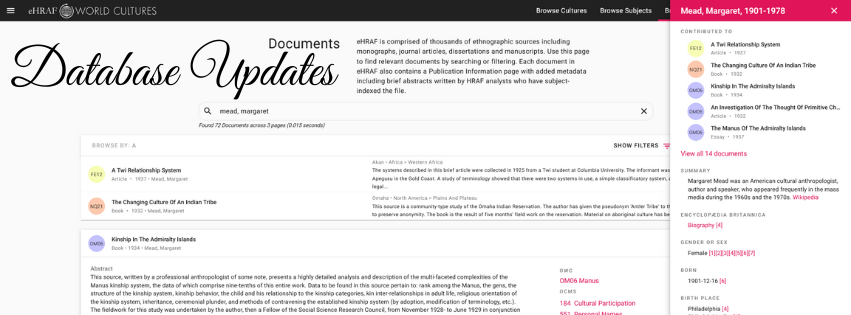
An exciting feature introduced to eHRAF in 2025 are Author Profiles featuring biographical information about the more than 8,000 authors who have written the documents that make up eHRAF World Cultures and eHRAF Archaeology. Biographical data available for authors include:
- Gender
- Nationality
- Date and place of birth
- Date and place of death
- Occupation
- Country of education
… and many more fields. It is also now possible to filter eHRAF search results by author gender and country of education, with more filters coming soon. Learn more about eHRAF Author Profiles here.
In 2024, we announced that we would be adding a message inside the eHRAF databases in order to notify users how they are granted access to eHRAF. In most cases, the message shows the name of the accessing member library or institution. This feature will also notify users if they do not have access (or indicate that they have not successfully connected via their libraries). Member librarians will be pleased to learn that this message doubles as institutional branding for a more seamless user experience.

Example of author profile in eHRAF: Margaret Mead
We also announced in 2024 that HRAF had expanded Unicode support for phonetic transcription systems. This project is ongoing. Improvements to Unicode support for all documents continue to allow for better rendering of indigenous writing and phonetic transcription in both our existing and new collections. Our Engineering and Production teams are continually working to provide better specifications and enhanced monitoring during new conversions to support International Phonetic Alphabet (IPA), American Phonetic Notation (APA), and Uralic Phonetic Alphabet (UPA), as well as indigenous writing systems.
In addition to improved phonetic handling, our Engineering team has implemented a new version of XML document specifications in the system that HRAF analysts use to subject index and add metadata to documents for eHRAF. This update allows for better representation of different data structures, which will lead to better quality documents in eHRAF. What does this mean for eHRAF users? A major result of this enhanced document quality will be to better enable HRAF analysts to index documents for multiple OWCs (culture identifiers from the Outline of World Cultures). This means that users will be able to view and search culture collections that include ethnographic data covering more than one culture in a single document, such as multi-sited or comparative works. Most significantly, this infrastructural upgrade has been designed to support the ongoing publication of our Africana Diaspora files and future diaspora collections that coming soon (see Culture and Tradition Updates, above).
Finally, HRAF engineers conduct annual accessibility reviews as part of our continuous efforts to make eHRAF accessible for all users. Several fixes this year including adding a top-level heading to each page in eHRAF and ensuring all text had sufficient contrast with its background.
If you would like to explore eHRAF World Cultures and/or eHRAF Archaeology, but your academic institution is not yet a member, have your librarian contact us to apply for an IP trial.
New HRAF Advanced Cross-Cultural Research Course

With the support of the National Science Foundation (BCS #2020156), HRAF held three years of Summer Institutes for Cross-Cultural Anthropological Research from 2021-2023. This NSF award enabled the training and professional development of 44 scientists in anthropological science over three years. These faculty, researchers, and advanced graduate students received training in theory and state-of-the art methods for conducting regional and worldwide comparative research. An additional aim of the grant was to encourage that these methods be further incorporated more widely into courses and cross-cultural research using anthropological data.
The HRAF Advanced Cross-Cultural Research Course, launched in 2025, is an open access resource offered to disseminate the materials covered in the Summer Institutes to a wider audience. Published under the CC BY-NC-ND 4.0 license, students and instructors are welcome to follow along with this course and/or adapt these materials for teaching cross-cultural methods to a class.
The primary instructors for the Summer Institutes at HRAF were Carol R. Ember (Human Relations Area Files at Yale University, USA), Fiona Jordan (University of Bristol, UK) and Séan Roberts (Cardiff University, UK). Additional lectures were delivered by Damián Blasi, Alexandra Brewis Slade, Joshua Conrad Jackson, Jeremy Koster, Erik Ringen, Eleanor Power, and Amber Wutich. Francine Barone produced the online version of the course with the assistance of Ben Gelbart (video production), Ben Ostermeier (software and design) and additional support from HRAF’s Software Engineering team.
Staff Updates
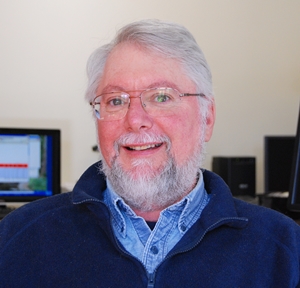
Leon Doyon
In October, we wished a well-deserved retirement to Leon Doyon, Managing Editor of Electronic Publications, who first began working at HRAF in 1999. HRAF is incredibly grateful to Leon for his many years of dedication and his commitment to meeting the myriad challenges of curating HRAF’s ethnographic, archaeological, and image collections over his 25 years of service. We wish him all the best for his next adventure.
Teresa Silva joined HRAF as Collections Editor in August, overlapping with Leon to receive training in the HRAF production process and his meticulous standards for eHRAF data prior to his retirement. Andrea Knies also joined the production team as Document Imaging Assistant in 2025.
HRAF welcomed two new Melvin Ember interns for 2025-2026, Hattie Berke and Jonathan Zhang. The intent of the internship is to learn about cross-cultural research through practical experience. Jackie Heitmann, one of last year’s Melvin Ember interns, has carried on at HRAF this year to provide research assistance largely in the form of statistical analyses for HRAF grant publications.
Ben Gelbart, a former attendee at the HRAF Summer Institute, is working on grant data analysis while doing postdoctoral research in the Psychology Department at Yale.
Christina Bird joined HRAF in the role of Membership Assistant.
Research & Publications
HRAF features a selection new research in the HRAF Academic Quarterly, which showcases eHRAF-based cross-cultural research as well as promoting and disseminating findings from researchers at our member institutions. Each Quarterly also includes updates on publications and conference papers from HRAF researchers throughout the year.
In 2025, 57 articles, books and papers were featured. You can read them here:
HRAF Academic Quarterly 2025 Vol 1
HRAF Academic Quarterly 2025 Vol 2
HRAF Academic Quarterly 2025 Vol 3
HRAF Academic Quarterly 2025 Vol 4
Sign up here to be notified of new issues when they are published. If you would like your research based on eHRAF or HRAF data to be featured in the next edition, contact Francine Barone.

Explaining Human Culture
Explaining Human Culture (EHC) aims to help scholars search for previous cross-cultural studies on topics of interest as well as to provide overviews of topics for which we have a considerable body of research. The EHC database, now containing over 1,250 reports, summarizes the purpose of each study, the hypotheses tested, whether the hypotheses are supported or not, the important variables in the study and the subject-categories in eHRAF that may apply to these variables. Every topical summary also includes a section on what is not yet known in order to stimulate further research.
The topical summary on Hunter-Gatherers (Foragers) was revised in 2025 with an updated version by Carol Ember with assistance from Jacqueline Heitmann and Sebastian Wang Gaouette, Melvin Ember Interns. The hunter-gatherer way of life is of major interest to anthropologists because dependence on wild food resources was the way humans acquired food for the vast stretch of human history. Cross-cultural researchers focus on studying patterns across societies and try to answer questions such as: What are recent hunter-gatherers generally like? How do they differ from food producers? How do hunter-gatherer societies vary and what may explain their variability? Research on hunter-gatherers continues to be of major interest to anthropologists and other social scientists. We have updated and revised this summary with more recent research.
The next summary module, Armed Combat and Warfare, is expected to be published in Spring 2026.
Ethnolab and Enhanced Data Services

On the HRAF engineering roadmap for 2026 are powerful computational tools for cross-cultural research that we have been developing for the past few years (accelerated by our NSF-funded iKLEWS Project). The aims of that project and some of the resulting enhancements that we will be announcing in 2026 include: a) expanding the metadata for the eHRAF database using data mining, deep learning and a range of textual analysis, b) providing limited data sets for data mining by researchers through an API (application programming interface); c) developing services that leverage the API to process results; and d) providing a range of approaches to this that suit researchers with different levels of technical skill, including web applications, JupyterLab workflow templates, and direct API access.
The services and tools resulting from iKLEWS are known collectively as Ethnolab. You can preview API examples of Word2vec services developed by Ben Kluga and Michael Fischer – topical search, and search by example – along with technical documentation and a Word2vec tutorial, here.
Also as part of Ethnolab, we intend to expand search functionality in eHRAF. In the future, all eHRAF members will benefit from enhancements to the eHRAF databases as the result of Ethnolab integrations, including: smarter, more intuitive search that is finer-grained; improved visualization and comparison tools for identifying patterns across cultures; and semantic relationships within ethnographic texts that go beyond simple keyword matching.
Finally, new data services (in addition to those that will become available to all existing members) are currently in the latter stages of development while we work with selected advanced research groups in refining these offerings to meet evolving researcher needs for scientific inquiry. Our initial offerings seek to balance random and topical sampling from our corpus while adhering to fair usage guidelines. HRAF Membership will announce details about availability and pricing when the Enhanced Data Services offer becomes available.
Conferences & Events
In January, HRAF President Carol Ember visited the Columbia Climate School to make a presentation titled Cultural Adaptations To Natural Hazards and Resource Stress for the Research Seminar Series. Carol’s presentation featured the findings from grant-supported interdisciplinary cross-cultural research looking at the effects of climate-related hazards on culture.
HRAF Anthropologist Ian Skoggard chaired the panel, “What’s New in Cross-Cultural Research? (SCCR)” at the 85th Annual Meeting of the Society for Applied Anthropology in Portland, Oregon, in late March. Several HRAF staff members and affiliates presented papers, including: Michael Fischer, Sridhar Ravula, Samantha King, Anj Droe, Cynthiann Heckelsmiller, Carol Ember, Ian Skoggard, Jaqueline Heitmann, Seb Wang Gaouette, Eric Jones, Ann Nguyen, Ian Skoggard, Louise Toutée and Isana Raja.
The Second Conference on Love Studies took place from March 14 to 16, 2025. Ian Skoggard is a member of the advisory board for the conference and he was also the chair of a panel session on “Evolutionary and Cultural Perspectives on Love”. Among the six presentations in the panel was Ian’s paper on “Love Motifs in Taino and Pueblo Art”.
Also in the Spring, HRAF exhibited at the 90th Annual Meeting of the Society for American Archaeology from April 23–27, 2025, in Denver, Colorado. Finally, we finished the year with the American Anthropological Association Annual meeting in New Orleans, LA. Visitors to the exhibitors’ booth received free trials, tote bags and exclusive discounts for attending.

Ben Kluga (center) and Michael Fischer (right) presenting at the 2025 AAA Annual Meeting
HRAF Vice President Michael Fischer and Engineer Ben Kluga presented “Ethnography as Language Model: Speaking Beyond the Text”, a poster exploring the use of Large Language Models (LLMs), or Generative Artificial Intelligence, as tools for dynamically evaluating ethnographic writing. The poster utilized the previous generation of language models, both as a tool for semantic inquiry as well as an entry into understanding how LLMs work.
At the 2025 AAA Annual Meeting, the Society for Anthropological Sciences (SAS) awarded the Carol R. Ember Book Prize to Manvir Singh for his book, Shamanism: The Timeless Religion. Manvir Singh combines ethnography with cross-cultural analysis and insights from the cognitive sciences to explain why shamanic practices reliably emerge across human societies. He shows that shamanism endures as a powerful, recurrent cultural form because it taps into universal psychological mechanisms while adapting to diverse historical and social contexts. The award committee noted that this work surveys shamanism using ethnographic research, cognitive methods, and cross-cultural datasets. It is written for any audience, yet without exoticizing cultural differences or downplaying anthropological theory.
HRAF Global Scholars
We are pleased to announce the seven recipients of the HRAF Global Scholars Program for 2026. Please join us in congratulating the successful applicants whose eHRAF research we will feature throughout the year.
Stay in touch
As always, our Facebook, Instagram, Bluesky, and LinkedIn will keep you in the loop, but should you want to get first dibs on our latest announcements, remember to sign up for the HRAF newsletter and, for research updates, the HRAF Academic Quarterly.
Photo credits
Date block header image by pw.studio from PW.Studio via Canva Pro
Man reading book in a quiet library setting by Murad Khan from Pexels via Canva Pro
Leon Doyon portrait by Paul Anthony Moore
Screenshots by HRAF
